 |
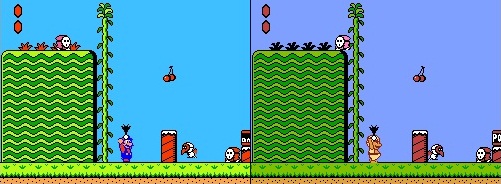
| Comparison of Super Mario Bros 2 (Left) to Doki Doki Panic (Right) |
So it's 1988 and you just bought a copy of
Super Mario Bros 2 and you pop that thing into your NES and you realize that this doesn't play anything like the first game. You don't beat enemies by jumping on them, vertical platforming is a thing, and there's a need to sometimes move to the left. Why is that? Well that's because
Super Mario Bros 2 in the United States isn't actually
Super Mario Bros 2. It's actually a game called
Doki Doki Panic that was released exclusively in Japan for the Famicom disc system. The original
Mario 2 was supposedly too hard with new mechanics that the team porting it over decided that a western market might be turned off by this so what was done was that the team contacted Nintendo's headquarters and told them "
Mario 2 is too hard do you have any other games"? And with that, a modified copy of
Doki Doki Panic made it to the US and it Mario skin painted over so that the US would like that game. This was probably done as a way to maximize sales in fear that the original copy of
Mario 2 wouldn't sell due to being too difficult. So swapping it out with a game that is similar enough seemed to do well on that one. But that being said the original version of
Mario 2 would later be released as the
Lost Levels in the Super Nintendo compilation
Super Mario All-Stars in 1993.
But this isn't the first instance that something like that had happened.
The Legend of Zelda almost never made it into the states in 1986 due to it being too difficult. But that eventually did make it. The other games that didn't make it to the states were the entire
Fire Emblem series up until it's seventh release in
Binding Blade and half of the
Final Fantasy releases from the Famicom and Super Famicom systems. Now in terms of
Final Fantasy the first game was actually really popular in the west so it's actually a little surprising that
Final Fantasy 2, 3, and 5 weren't ported over because they weren't that good. But with four and six, those were brought over as two and three respectively because those two did very well in Japan. Two was actually really, Three didn't get localized because of how bad Two was. and Five is a weird case. It was great but it didn't really have much impact on the franchise as a whole. Honestly, Square Software probably didn't want to pull resources to localize a game that didn't really sell that well in it's home country so it makes sense that it wouldn't want to bring it over to the States where it would probably sell even less.
 |
| Captured on 3DS hardware |
In
Fire Emblem's case, being a strategic RPG and a glorified version of chess, this again brought into the idea that Western players were seen as a group who wouldn't find much fun in a game that uses strategy and something a bit plot heavy. Basically, Japan didn't think that the United States are smart enough to handle that game until the release of
Super Smash Bros Melee in 2002 to get them to release
Binding Blade in 2004 and most games have made it back since then.
Comments
Post a Comment